
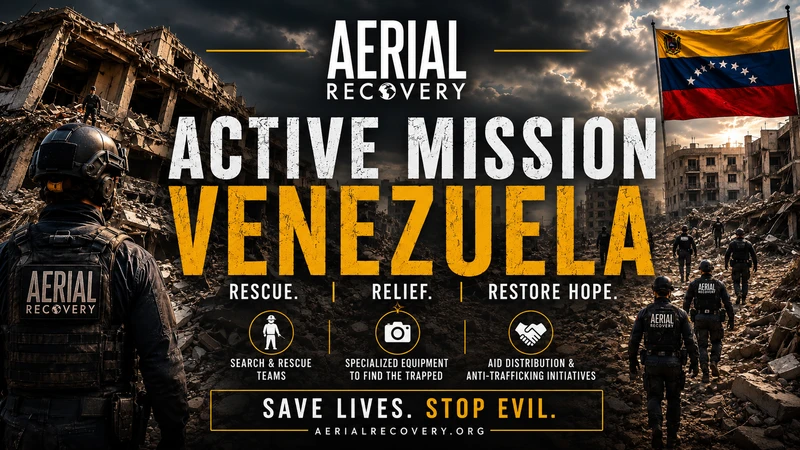
As the death toll from Venezuela’s twin earthquakes climbs past 1,400 with tens of thousands still missing, the nonprofit Aerial Recovery is deploying specialized teams to fight on two fronts at once: pulling survivors from the rubble before the rescue window closes, and confronting the wave of trafficking and abuse that history shows targets survivors once the cameras leave.
The earthquakes struck on June 24, two quakes of magnitude 7.2 and 7.5 hitting just 39 seconds apart, roughly 100 miles west of Caracas. They are the strongest to hit Venezuela in more than a century. Entire buildings collapsed with families inside across La Guaira and Caracas. The confirmed death toll is rising by the hour, and U.S. Geological Survey modeling projects a substantial probability that the final count exceeds 10,000, with a real possibility of surpassing 100,000.
The most urgent need is recovery capacity inside a narrowing window. The first 72 hours are when trapped survivors are most likely to be found alive, and that window is now closing. Venezuela’s civil protection services were stretched thin before the ground ever moved, and local responders have been digging since Wednesday, many with their bare hands and little rest. Aerial Recovery’s first priority is to bolster those exhausted teams. The organization is focusing its specialized operators, canines, equipment, and resources on saving every life that can still be saved and reinforcing the responders who have not stopped since the first tremor.
Aerial Recovery’s partners are already operating in the affected zone. The organization’s own teams will arrive within 24 hours, bringing specialized search and recovery equipment and working to clear certified canine search-and-rescue dogs into the country to speed the location of people buried in the rubble. Those teams are made up of special operations veterans and first responders trained through Aerial Recovery’s Heal the Heroes program, which repurposes veterans for humanitarian special operations. They will work by, with, and through Venezuelan authorities and local responders already leading the effort.
The second front is the one that rarely makes the news. For decades, UNICEF and the United Nations have documented a brutal pattern: in the chaos after a disaster, predators move to sell separated and orphaned children into sexual exploitation, forced labor, and illegal adoption, exploiting the collapse of the systems that normally protect them. A child’s risk rises sharply the moment they are orphaned, displaced, or separated from family, and globally, children already account for more than a quarter of all identified trafficking victims. After the 2010 Haiti earthquake, the UN went on specific alert to stop traffickers from seizing the thousands of children wandering in search of food and shelter. Sexual abuse inside overcrowded shelters is a documented and recurring danger in these conditions, not a hypothetical one.
That history is why Aerial Recovery’s mission does not end at the rubble. While in country, its teams will provide protection in affected regions for newly orphaned and at-risk children, act as a deterrent against the traffickers who follow disasters, and work directly with shelters to harden them against sexual abuse within their walls.
“There are two clocks running after an earthquake like this,” said Britnie Turner, Co-Founder of Aerial Recovery. “The first is the rescue clock, the 72 hours when a survivor can still be pulled out alive. The second is the one almost no one talks about. It is the window when traffickers move on the children who just lost everyone who ever protected them. The data has been screaming this at us for decades. Disaster is when predators hunt, because they know the world is staring at the rubble and not at the child being led away from it. So we refuse to choose. Saving lives and stopping evil are not two missions. In a disaster, they are the same mission, and we will run both clocks until the work is done.”
“The hardest part of coming home from war is losing the mission. We give it back,” said Jeremy Locke, Co-Founder of Aerial Recovery and a former Special Forces operator. “The same training that took our people into the worst places on earth is exactly what pulls a child out of a collapsed building and exactly what stands between a trafficker and an orphan. We don’t retire that capability. We aim it at saving lives, and the veteran who does that work heals something in themself in the process.”
Aerial Recovery is coordinating its response with local authorities and partner organizations and will provide operational updates and field documentation as the mission progresses.


